
You can only kick the can so far
A local budget reckoning

Any reasonable budget discussion starts with two things: how much can be spent, and what's already committed. For Massachusetts cities and towns these mandatory budget items are things like contractual commitments, pensions and retiree healthcare obligations, and required levels of spending on K-12 education. Once the things that cannot be avoided are agreed upon, a realistic discussion of the actual options can be had.
The ongoing municipal budget discussion here in New Bedford seems typical, at least for urban communities in Massachusetts this year. To date, it has for the most part taken place in the media and online. The bulk of the “discussion” has taken the form of a reaction to the mayor’s budget proposal, especially his proposal to close a fire station. Things appear to have cooled down a bit recently following news that the FY27 Senate budget earmarks $500,000 directly to the New Bedford Fire Department.
Widely viewed as a reprieve, the earmark in fact covers only a fraction of the annual cost of operating the fire station. According to the New Bedford Light, the City’s CFO estimates the all-in annual cost (including salaries and benefits) of operating a fire company in FY27 will be $1.8 million.
In practice, retaining the fire station for a single year will require not only the $500,000 earmark, but also $1.3 million in additional cuts on top of that from other Departments where city leaders are empowered to make cuts. This is true regardless of how one feels about the fire department or the position one takes on the merits of the mayor’s proposal1.
The larger point here is that thoughtful and responsible budget discussions should consider all the costs, benefits, tradeoffs, and available options. The public discussion about municipal finances has not been particularly thoughtful or evidence-based so far here in New Bedford, and it appears to be similarly contentious in a number of other communities in Massachusetts dealing with budget shortfalls.
In an effort to try to do something about that, and in the spirit of my last post, my aim here is to bring some important context to ongoing municipal budget deliberations both in New Bedford and elsewhere.
Four fiscal facts of life frame New Bedford’s budget options in the current environment. Many communities across the state are confronting similar challenges.
1) State aid has roughly doubled, but unrestricted funding has lagged
State aid to New Bedford has grown substantially since FY2008/09, climbing from about $145 million to roughly $309 million in FY26 (Cherry Sheets, Division of Local Services, DOR). Almost all of that growth came from Chapter 70 education aid, which can only be spent on the New Bedford Public Schools. Unrestricted general government aid — the portion local leaders can actually decide how to use — has lost ground when inflation is considered.
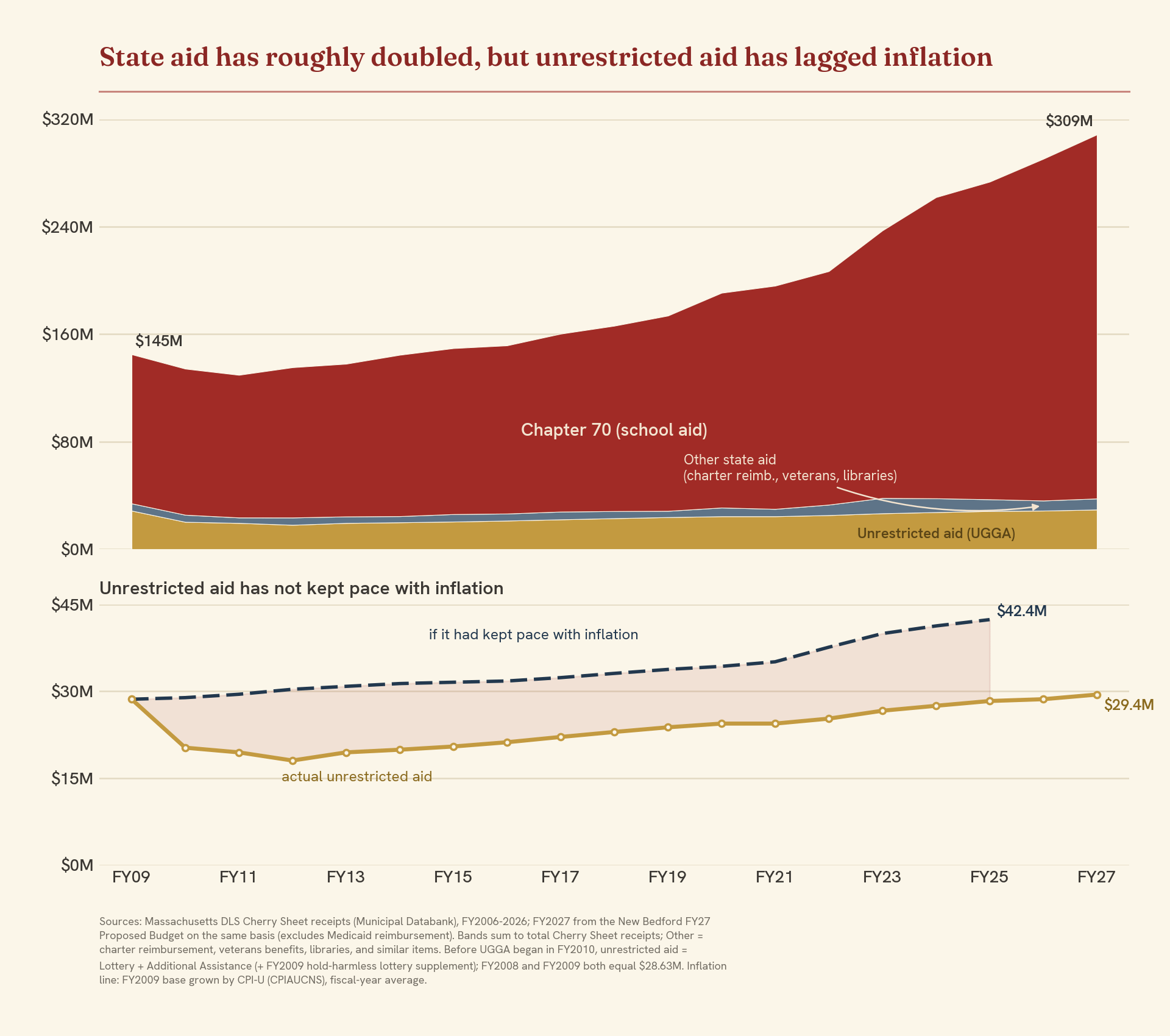
So it isn't fair to say the state has failed to do its share to support New Bedford — but it is accurate to say that unrestricted state aid has not kept pace with inflation. Those funds, however, make up less than 10 percent of the state aid assumed in the mayor's FY27 budget proposal. Every dollar helps, and the frustration of local officials who find themselves with less and less discretion over the city budget is understandable. But it is hard to credibly pin the city's larger budget challenges on a lack of state financial commitment to New Bedford.
2) Charter school tuition expenses have risen substantially
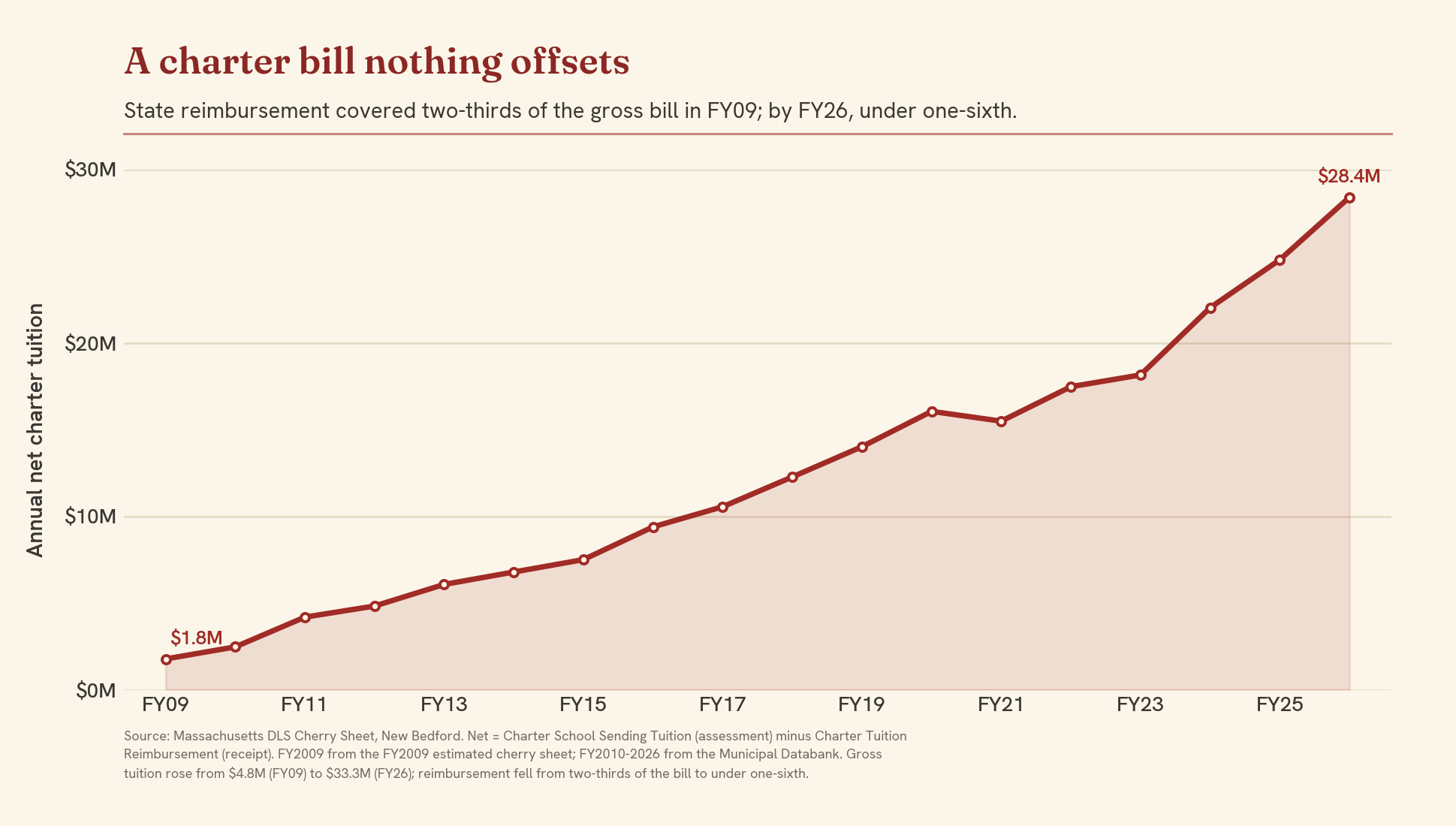
For most of the last two decades, New Bedford’s charter school tuition payments have climbed significantly. In FY2009 the city sent 420 students to Commonwealth charter schools, and had roughly $4.8 million deducted from its state aid (cherry sheet allocation) to cover those expenses. By FY2026 charter enrollment had nearly quadrupled, to about 1,565 students, and the tuition bill had grown nearly sevenfold, to $33.3 million. Enrollment growth explains only part of that climb. Tuition per charter student also rose sharply, from roughly $12,900 in FY2018 to about $21,300 in FY2026, as the Student Opportunity Act lifted the underlying per-pupil rates on which charter tuition is built.
What the city actually absorbs is the tuition net of what the state reimburses, and that net cost has grown faster than either enrollment or tuition. New Bedford’s charter reimbursement was about $3.0 million in FY2009, which was enough to offset roughly two-thirds of its tuition bill that year. By FY2026 the state reimbursement covered less than one-sixth of the tuition.
Net charter tuition payments rose from about $1.8 million to roughly $28 million between FY09 and FY26, about a sixteen-fold increase during a period where charter enrollment grew by about fourfold.
There’s a deeper asymmetry beneath these charter costs, and it cuts against cities like New Bedford. When enrollment falls in a rural or suburban district, the state’s “hold harmless” provision lets it keep its Chapter 70 aid anyway — and those benefits flow disproportionately to wealthier and rural communities with declining enrollment. New Bedford gets no such cushion, because its enrollment hasn’t fallen appreciably.
Charter tuition rises, but since the city receives the Chapter 70 aid for those students those allocations roughly offset the tuition in principle. That offset is a true saving only if a departing student takes their share of the full cost with them. In practice they don’t. New Bedford serves roughly as many students as it did fifteen years ago, in the same buildings, on the same buses, and with the same staff requirements. A student who enrolls in a charter saves the district only the marginal cost of serving that student, while the tuition is set at the district’s average cost per pupil.
The difference is the real local cost of charter enrollment. The students the city sends to charters haven’t freed the district from its fixed operational or facilities costs, because the number of children it serves hasn’t declined appreciably. And the same law that raised New Bedford’s foundation budget — the Student Opportunity Act — also raised the tuition it owes its charters, while the reimbursement meant to bridge the gap has lagged. For a stable-enrollment Gateway city, the charter assessment is a large claim on the budget that nothing comes close to offsetting. And it grows fastest when state investment in public education grows.
3) Most of the budget is already obligated and non-discretionary
In practical terms, only about 18 percent of New Bedford’s city budget — in the FY27 budget proposal roughly $97 million of the $535 million — is discretionary in the sense that the City can reduce it and realize real savings in FY27. The remaining 82 percent is either legally fixed (net school spending requirements, mandatory pension assessments, charter school tuition, debt service, and a multi-year waste contract) or fixed as a practical matter (the employer share of health insurance and claims-driven costs like unemployment and workers’ compensation, which can theoretically be reduced but are ultimately unavoidable obligations).
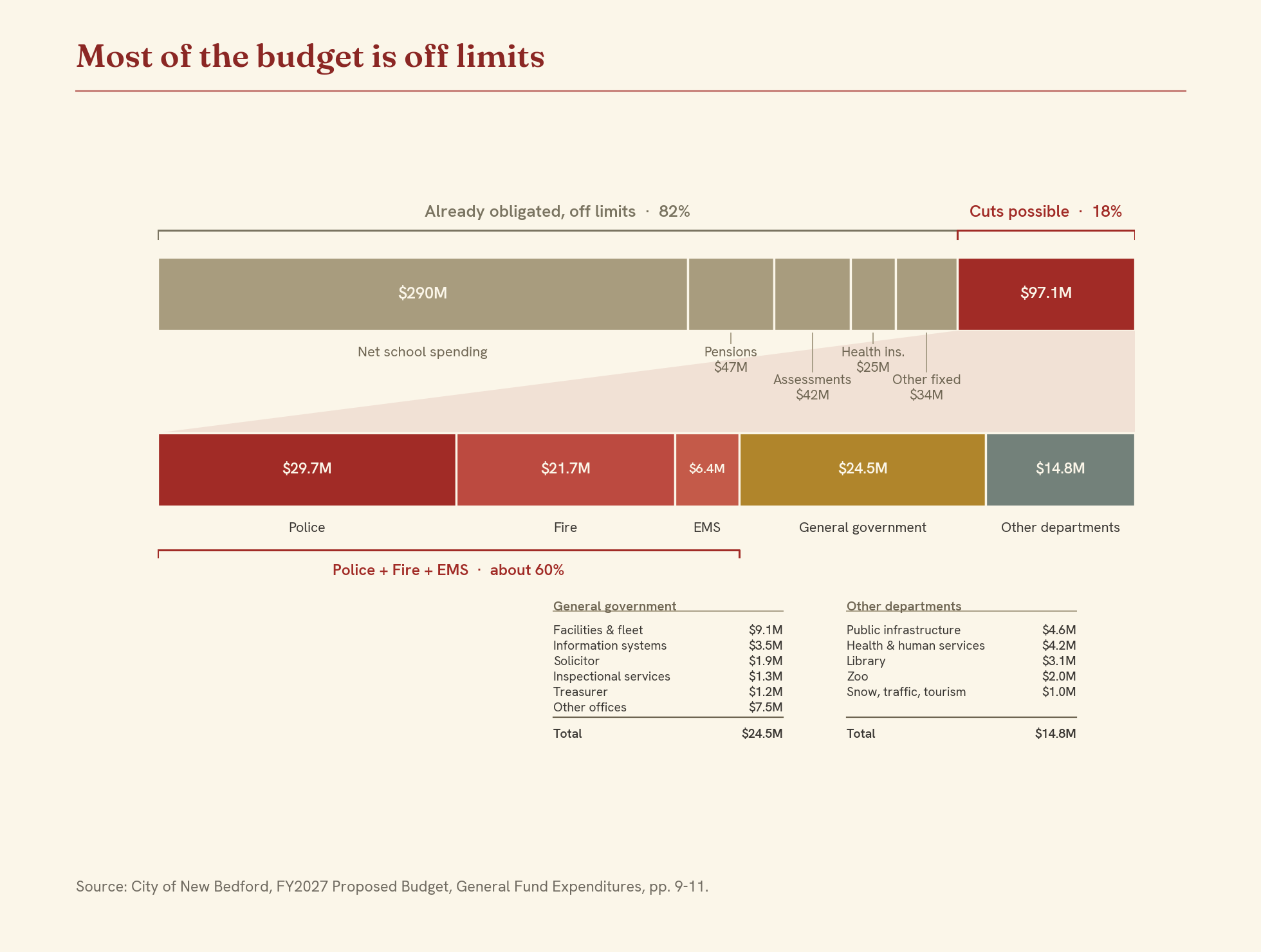
In New Bedford, the FY27 budget proposal raises tax collections to the levy limit. There is no discretion to increase tax receipts above this limit without an override vote, or much stronger levels of new economic development and “new growth” than has been experienced over the past decade. This leaves city leaders between a fiscal rock and a hard place.
4) There are no easy answers
None of this means the city is without options. But meaningful and credible budget solutions require agreements and commitments that extend well beyond a single budget year. In other words, a durable commitment to meaningful change. The way the city chooses to manage its health care and pension liabilities is one major area that local leaders would be wise to examine carefully.
Managing employee and retiree health care costs
Joining the state Group Insurance Commission (GIC), which provides benefits to active and retired state employees and municipalities that opt in, is one option worth serious consideration. In New Bedford, the mayor has repeatedly proposed it but it has been consistently resisted.
Joining a larger insurance pool can help manage rising insurance costs, especially in communities like New Bedford that have a relatively small group to insure. The GIC would guarantee municipal employees receive the same health care benefit options as state employees.
A 2009 study by Robert Carey, commissioned by the Collins Center and the Rappaport Institute, assessed Springfield’s results after it joined the GIC in 2007. It found that GIC entry reduced the city’s health care cost increases by an estimated $14 to $18 million over two years in a much larger community and a very different fiscal environment. In an environment where costs are rising rapidly, any savings associated with GIC membership are likely to be experienced as slower growth in health insurance and related costs. Notably, there has been a recent surge in municipalities joining the GIC.
New Bedford is exactly the kind of small group that risk pooling is designed to help. The resistance is not irrational. GIC entry moves health-benefit design out of local collective bargaining, and that is a genuine loss of local control. But the real choice is not GIC against the status quo. It is GIC against continuing to fund benefits and raises by cutting services, with the levy at its limit.
In New Bedford, the mayor’s FY27 budget proposal raises the health insurance line 19.8 percent over FY26 and zeroes out the modest annual transfer the city had budgeted toward its unfunded retiree health care liability (OPEB), which is essentially being funded on a pay-as-you-go basis, with under 2 percent set aside against a half-billion-dollar liability in FY252.
Local pension obligations
The mandatory annual contribution to employee pension expenses and liabilities is not subject to local approval. These contributions are scheduled to rise significantly in coming years in many communities. New Bedford is one of them.
New Bedford’s required contribution is scheduled to rise from about $46 million in FY2025 toward roughly $81 million by 2035, the year the system is due to be fully funded. For purposes of the annual city budget, the required contribution is not optional. About 88 percent of the required payments are the city’s responsibility, and with the tax levy at its limit, every additional dollar must come from some other area of the discretionary budget. Payments are currently scheduled to rise by 8 percent a year through FY2029.
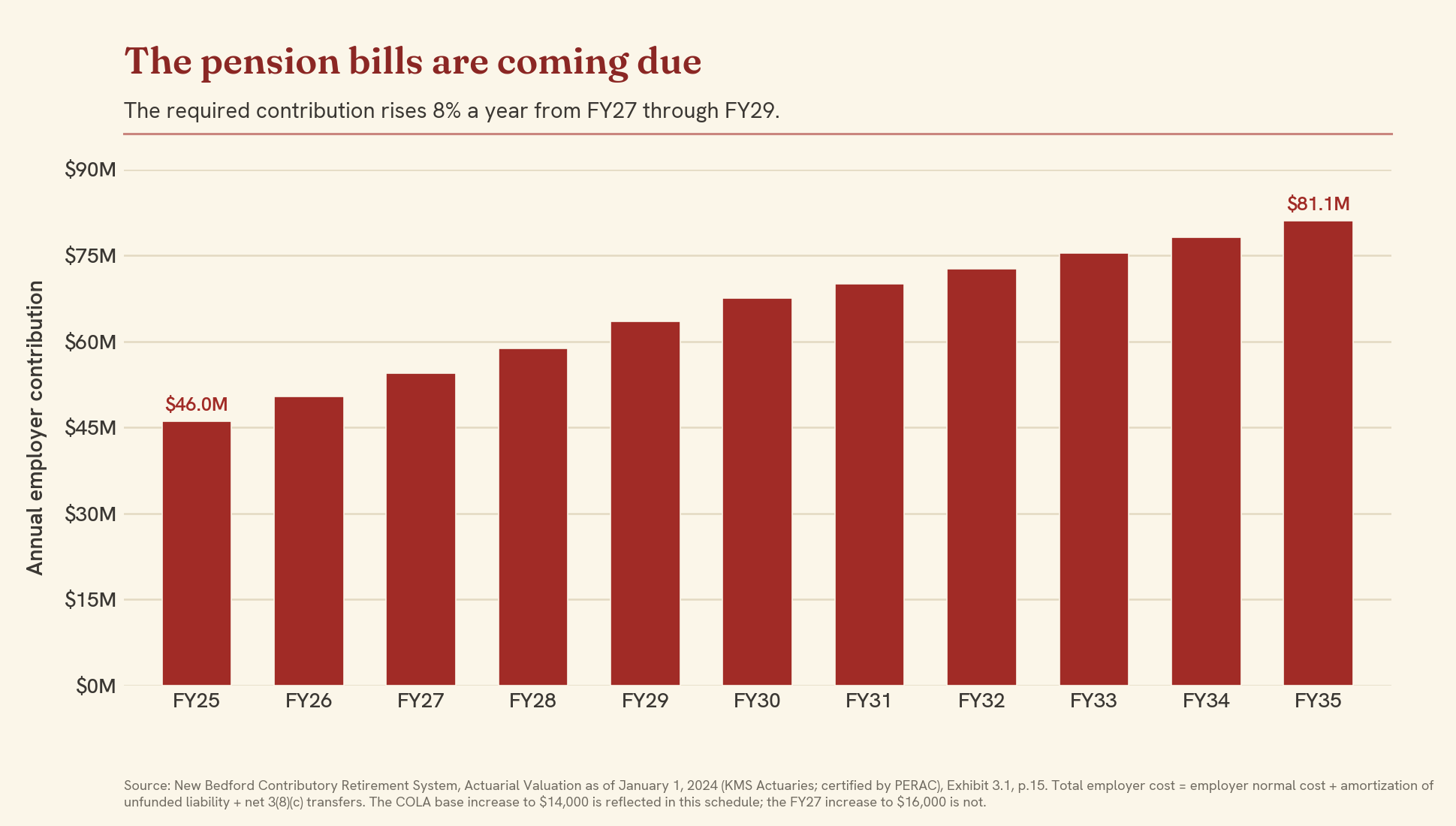
When the next market downturn happens, there will be statewide pressure, as there was following the 2008/2009 financial crisis, to extend the deadline for fully funding local pension systems. State law allows the system to push full funding from 2035 to 2040 with approval from its regulator (PERAC), which would lower the city’s near-term contributions meaningfully. While that would provide real budget relief in the short-term, it would be the very definition of kicking the can down the road and would significantly increase long-term expenses and financial risks.
In this context, it is worth separating the routine cost of living adjustment (COLA) from the most recent change to it. There is a very strong case for the COLAs themselves, given the rising cost of living and the low benefit levels most New Bedford retirees receive.
The recent decision to raise the highest benefit level those COLAs apply to — from $14,000 to $16,000 — will, however, add to the upward pressure on mandatory annual municipal contributions.
The final cost won't be known until the fund's next valuation, but the mayor’s estimate of about $1.1 million a year is consistent with what the latest official valuation implies. That report documents the earlier increase — from $12,000 to $14,000 — added roughly $8 million in liability. Against that benchmark, and on the current amortization schedule to the 2035 full-funding target, $1.1 million is a reasonable estimate of the annual cost of the Board's recent vote to raise the COLA base to $16,000.
But what about the audit?
It has been impossible to avoid the public discussion over the audit of the Legislature’s accounts, programs, activities, and functions that the State Auditor and a large share of voters backed through a 2024 ballot initiative. Some readers may be thinking, where is my audit? Some appear to believe that this audit will uncover “waste, fraud, and abuse” and allow the state to invest more in local aid, thereby helping to close local budget gaps.
Leaving aside legitimate constitutional concerns about the separation of powers, the fact that state finances are already independently audited annually, and the state Auditor’s official role is to conduct performance audits, there is no meaningful savings to be had from those accounts. As a practical matter, an audit of the operational budget and administrative practices of the state legislature matters little to local budgets, since those accounts are the equivalent of a rounding error in a $60+ billion state budget.
Even if the state legislature zeroed out its own budget and redirected it all to local aid, that budget is simply not large enough to make a material difference to any given city or town, New Bedford included. This is true regardless of how one feels about the merits of the audit ballot question, the constitutional questions it raises, or the actions or performance of the Legislature.
Final thoughts
Many Massachusetts communities face challenges, choices, and constraints like those confronting New Bedford. Before they can be addressed, there must be a shared understanding of the basic fiscal realities communities across the Commonwealth are facing.
A serious debate distinguishes one-time relief from recurring revenue, real choices from symbolic gestures, and money that is available from money that is already committed. We would all benefit from a more candid discussion of the realistic options. And we all deserve better than grandstanding, finger-pointing, and kicking the can down the road.
Budgetary decisions are almost always about tradeoffs. It is not hard to imagine some of the areas that could be cut instead could have worse unintended consequences. The details matter.
Interested readers should check out the relevant evidence on the questions of firefighter staffing levels and public and firefighter safety raised by the proposed changes — see NIST, 2010, JB Consulting 2022, and Stingley, 2011 — and judge for themselves.
For more background on how to evaluate a local pension system and definitions of key terms and concepts, see National League of Cities (2017).